

Climate Feedback Loops
Climate Feedback Loops are processes in the Earth system that can either amplify or dampen the effects of initial changes in climate. Understanding these loops is essential for accurate climate forecasting and for designing effective strategies to protect ecosystems and human communities. This article explores the most important feedback loops, explains how they work, and discusses why they matter for nature conservation and policy planning.
What Are Climate Feedback Loops
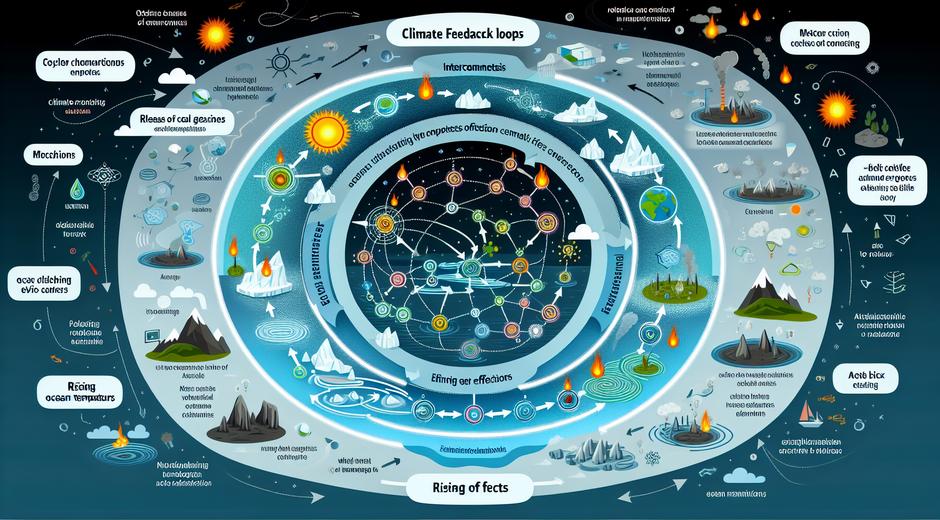
A climate feedback loop starts when a change in the climate causes processes that then push the climate in the same direction or in the opposite direction. A loop that amplifies the initial change is called a positive feedback loop while a loop that counteracts the change is called a negative feedback loop. Positive feedback loops can accelerate warming and lead to abrupt changes in ecosystems. Negative feedback loops can slow warming and stabilize systems. Both kinds shape the trajectory of global and regional climates.
Key Positive Feedback Loops
Several positive feedback loops are central to current climate concern. One of the most widely discussed is the ice albedo feedback. When ice and snow melt they expose darker land or ocean surfaces. Darker surfaces absorb more solar energy which raises local temperature and causes more melting. This loop is especially strong in polar and alpine regions where seasonal snow and sea ice respond rapidly to temperature shifts.
Another critical loop involves permafrost. Permafrost stores large amounts of organic carbon. As soils warm and permafrost thaws, microbial activity increases and trapped carbon is released as carbon dioxide and methane. These greenhouse gases trap heat and lead to further warming which causes more permafrost thaw. The potential for massive reemission from thawing soils is a major source of uncertainty in climate projections.
Water vapor is a potent greenhouse gas and its concentration in the atmosphere increases as the air warms. Warmer air holds more moisture which boosts the greenhouse effect and leads to further warming. Because this loop operates on global scales and interacts with cloud processes it has a strong influence on climate sensitivity.
Clouds and Complexity
Cloud feedbacks are among the most complex and uncertain. Some cloud types reflect sunlight back to space and cool the surface while others trap heat and warm it. Changes in cloud cover, altitude and style can either amplify or dampen warming. Small changes in cloud behavior can have large impacts on net radiative forcing and on climate models. Researchers prioritize better cloud observations and model representation to reduce uncertainty.
Ocean Heat Uptake and Circulation Changes
Oceans absorb most of the excess heat from greenhouse gas forcing. This heat uptake delays surface warming but can alter circulation patterns. Changes in ocean currents can influence regional climates and feedback on atmospheric systems. For example slowing of major currents can reduce heat transport to high latitudes leading to regional cooling even as global average temperatures rise. Complex interactions between heat uptake, sea level and ocean biogeochemistry create feedbacks that are still being mapped by scientists.
Vegetation and Land Cover Feedbacks
Vegetation cover affects albedo, evaporation and carbon storage. Drought stress wildfires and large scale changes in land use can shift ecosystems from carbon sinks to carbon sources. For instance when forests burn they release stored carbon and reduce the landscape capacity to absorb carbon dioxide. In some regions tree mortality caused by pests or drought can trigger transitions to shrublands or grasslands which may reflect more sunlight or store less carbon. These changes feed back into local and global climate.
Tipping Points and Abrupt Change
Feedback loops can push systems toward tipping points where a small additional forcing causes a large and possibly irreversible change. Examples include the collapse of ice sheets major shifts in ocean circulation and large scale dieback of forests. When thresholds are crossed the resulting changes can be rapid and difficult to reverse. Monitoring early warning signs and strengthening resilience in vulnerable ecosystems are essential strategies to reduce the risk of crossing dangerous tipping points.
How Scientists Study Feedback Loops
Researchers use a combination of observations experiments and models to study feedback loops. Long term monitoring networks record changes in ice permafrost soil and vegetation. Laboratory and field experiments reveal mechanisms such as microbial response to warming. Global and regional climate models integrate these processes to project future changes. Interdisciplinary teams combine climate science with ecology social science and economics to understand impacts and to design adaptation and mitigation measures.
Uncertainty and Risk Management
Feedback loops add uncertainty to climate projections. This uncertainty complicates planning for nature conservation infrastructure and human communities. Risk management therefore emphasizes flexible approaches that work across a range of possible futures. Conserving intact ecosystems restoring degraded landscapes and reducing greenhouse gas emissions lower the chance that positive feedback loops will lead to catastrophic change. Targeted monitoring can give early warning and allow managers to act before changes become irreversible.
What Can Be Done
Mitigation of greenhouse gas emissions remains the most direct way to limit the activation of dangerous feedback loops. Policies that cut fossil fuel burning and boost low carbon energy reduce the initial forcing that drives many loops. Conservation and restoration of forests wetlands and coastal ecosystems help maintain natural buffers that moderate climate impacts and sequester carbon. In some cases engineered interventions such as improved land management and soil carbon enhancement can reduce risk while natural solutions scale up.
Community level preparedness is also vital. Local restoration projects that stabilize soils improve water retention and support biodiversity while reducing vulnerability to extreme events. Science based land use planning can avoid placing infrastructure in areas at risk of abrupt climate driven change. Public education and stakeholder engagement help build the social consensus needed to implement long lasting solutions.
How Nature Lovers and Travelers Can Help
Citizen scientists and nature lovers play an important role by contributing observations that feed into scientific networks. Travelers who adopt low impact strategies support conservation and reduce emissions. If you want to learn about responsible travel options that emphasize nature protection and scientific engagement you can explore resources such as TripBeyondTravel.com which highlights ethical travel practices and projects that partner with local conservation organizations.
Further Reading and Resources
For more articles on nature climate interactions and practical strategies to protect ecosystems visit our main site at bionaturevista.com where you will find in depth guides case studies and ways to get involved. Explore sections on ecosystem monitoring carbon cycling and adaptation to deepen your understanding of how feedback loops shape the natural world.
Conclusion
Climate Feedback Loops are central to how the Earth will respond to ongoing changes in greenhouse gas concentrations. Some loops may provide stabilizing influences while others can greatly amplify warming and lead to abrupt changes. Effective action requires reducing emissions protecting and restoring natural systems improving scientific knowledge and planning flexibly for uncertainty. By combining global policy efforts with local conservation and informed public engagement we can reduce the chance that self reinforcing feedbacks push ecosystems and societies toward unsafe states.